
Cart is empty
 Books & CD/DVDs
 Orthodox Icons
 Monastic Handiwork
 Ecclesiastical Utensils
 Clothing & Accessories
 Natural Care & Remedies
 Prayer Ropes
 Jewelry
 Incense
 Wines
Wines
 Food
Food
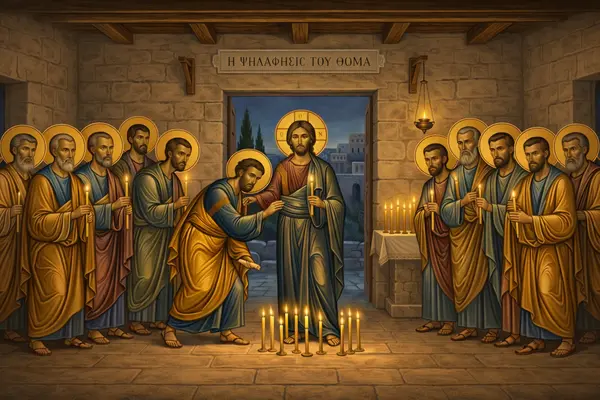
Sunday of Thomas: Touching Immortality and the Victory of Faith
Following the radiant Bright Week, our Church arrives at a milestone filled with humanity and spiritual depth: Antipascha, or as it is widely known, Thomas Sunday. This is the day when the Disciple’s "good unbelief" is transformed into the most resounding confession of the Orthodox faith.
1. The Historical Context: Eight Days Later
The story transports us to Jerusalem, to the Upper Room, eight days after the Resurrection. Although the Disciples had heard of the event, they remained "behind closed doors" for fear of the Jews. Thomas, who was absent during the Lord’s first appearance, refused to accept the testimony of the others.
Thomas’s "Objection": His refusal was not a product of stubbornness, but a profound human need for certainty. "Unless I see in His hands the print of the nails... I will not believe." This demand for "tangible" proof makes Thomas the ultimate representative of every thinking person throughout the ages.
The Second Appearance: Christ appears again, passing through the walls, proving that His Resurrected Body is not bound by the laws of matter. He addresses Thomas directly, inviting him to touch Him. At that moment, the history of humanity changes: faith ceases to be a theory and becomes an experience.
2. The Scene in the Upper Room: When Touch Becomes Theology
In Athonite iconography, the scene of the "Touching" (The Touching of Thomas) is rendered with staggering dynamism.
The Disciple’s Movement: Thomas is depicted reaching out in awe, while Christ raises His garment to reveal His pierced side. His wounds, instead of exuding death, radiate the Unwaning Light.
The Confession: The phrase "My Lord and my God" marks the first time one of the Disciples so clearly addresses Christ as "God." It is the pinnacle of the New Testament, where human logic bows before the Mystery of the Victory over Decay.
3. The Voice of the Fathers: Why Thomas Matters Today
The Athonite Elders often refer to Thomas as our "benefactor," as his doubt fortified our own faith.
Saint Paisios the Athonite: "Christ 'arranges' Thomas’s unbelief to help us. Had Thomas not touched Him, some might have said that the Resurrection was an apparition, a ghost. But now, we have the testimony of touch. The hardest proof."
Saint Porphyrios of Kavsokalyvia: He taught that Thomas possessed a "good restlessness." He calls us not to fear our questions, as long as we bring them before Christ with humility, asking Him to reveal Himself to us.
The Beatitude of Faith: "Blessed are those who have not seen and yet have believed." This word of the Lord is our legacy. We, who have not touched His wounds with our fingers, are called to sense Him through the Holy Eucharist and heart-centered prayer.
4. Bring the Blessing of "Antipascha" to Your Home
At Athonian.gr, we honor Thomas Sunday by offering items that enhance your personal "touching" of Grace:
Icons of St. Thomas: Authentic replicas of Athonite frescoes, where the intensity of the figure and the style compose a spiritual masterpiece.
Athonite Prayer Ropes (Komboskini) & Crosses: Handmade crafts that remind us that faith is a daily struggle of communication with the Risen Lord.
Lives of Saints, Athonite Recipes, Ascetic Texts, and Children’s Books: Discover how contemporary Saints experienced the presence of Christ as a living reality.
