
Cart is empty
 Books & CD/DVDs
 Orthodox Icons
 Monastic Handiwork
 Ecclesiastical Utensils
 Clothing & Accessories
 Natural Care & Remedies
 Prayer Ropes
 Jewelry
 Incense
 Wines
Wines
 Food
Food
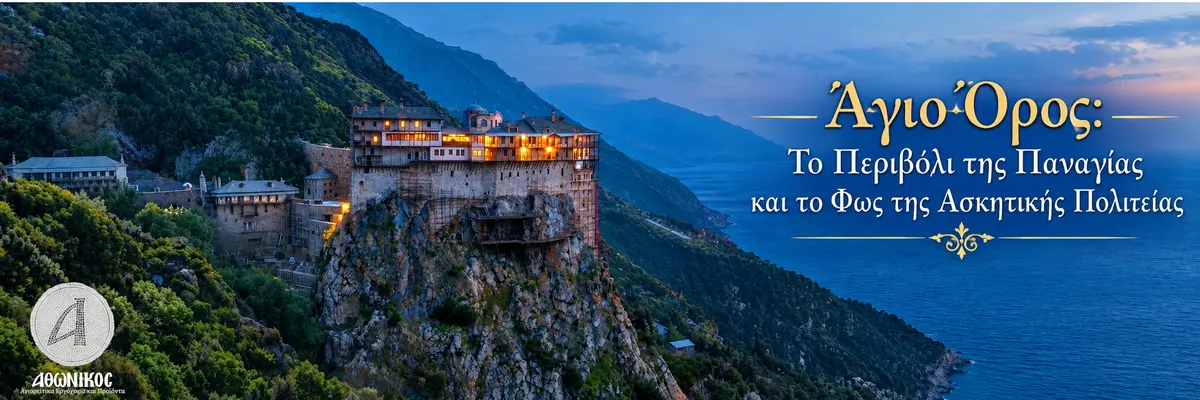
The History, Mystery, and "Avaton" of Mount Athos: The Garden of the Panagia and Its Rarest Violations
If you have never heard of Mount Athos before, imagine a lush, wild, and isolated peninsula in Northern Greece that seems to float between time, the sea, and the sky. In antiquity, this place carried myths; people believed that giants, such Athos, lived there and threw a massive boulder into the sea. However, the true soul of this place was born later, when the first Christian hermits and ascetics, driven away from worldly things, sought out the most precipitous caves to weep, pray, and live exclusively with God.
The tradition of our Church conveys to us with emotion the events surrounding the visit of the Most Holy Theotokos to the peninsula. After the Resurrection and Ascension of our Lord, the Panagia, desiring to visit Lazarus the Four Days Dead, who was then Bishop of Kition, boarded a ship along with Evangelist Luke and other disciples. During their journey toward Cyprus, a sudden and violent storm broke out on the Aegean Sea, dragging the ship far off course and threatening it with shipwreck.
The ship, guided by divine providence, was forced to make landfall on the shores of present-day Iviron, in the eastern part of Athos. The Panagia, disembarking upon that wild and isolated land, beheld the grandeur of nature and the absolute tranquility. The place immediately won her heart. At that moment, the pagan inhabitants of the region, upon hearing her preaching and feeling the divine Grace that surrounded her, were filled with awe, believed in Christ, and were baptized as Christians. The Theotokos, moved by their faith and the beauty of the landscape, raised her hands to heaven, blessed the entire peninsula, and asked her Son and God to make this place exclusively her own heritage, protected by her love. Since then, Athos has been established in the consciousness of the faithful as "the Garden of the Lady Theotokos," a place dedicated entirely to prayer.
The Birth of Organized Monasticism and the Evolution of the Monasteries
For someone coming into contact with the Athonite reality for the first time, it is worth understanding how this place transformed from isolated hermit caves into a global cradle of Orthodox monasticism. In the early Christian centuries and up until the 9th century, the peninsula was inhabited by individual ascetics who lived in absolute isolation, battling thoughts and the hardships of nature. There were no organized monasteries, nor communal services. Each person lived in a hut or a rock fissure, sustaining themselves with few dry rations and much prayer.
The major turning point came in the 10th century. In 963 AD, an emblematic ascetic, Saint Athanasios the Athonite, arrived on Mount Athos with the blessing and material support of the Byzantine Emperor Nikephoros Phokas. At that time, the first large, organized coenobitic monastery, the Great Lavra, was founded. This foundation changed everything:
A standard of communal life was established where monks no longer lived isolated, but shared meals, prayer, and obediences.
The foundation of other major monasteries followed, such as Vatopedi, Iviron, Hilandar, and many others, shaping the map of the monastic republic.
The emperors of Constantinople issued the famous "Chrysobulls," establishing special privileges, tax exemptions, and securing the geographical boundaries of the peninsula.
The "Avaton": Its Theological and Social Dimension
To an outside observer or someone unfamiliar with the tradition, the rule of the "avaton", meaning the absolute prohibition of entry to women, as well as to any female animal, often sounds strange, strict, or even outdated. However, understanding it requires setting aside modern secular criteria and delving into its theological foundation.
1. The Defense of Woman in the Church
First of all, it must be emphasized with absolute clarity that the avaton is not put forth in a derogatory manner toward women. In the Orthodox Church, the person honored more than any other, after Christ Himself, is a woman: the Most Holy Theotokos, the Mother of God. The Panagia herself is the "Lady" and the sole "hostess" of the entire peninsula. No other woman is allowed to dwell there, because this position belongs exclusively and solely to the Panagia.
2. The Space of the "Desert" and Ascetic Struggle
Mount Athos functions as an earthly desert. In the monastic tradition, cutting oneself off from worldly things involves avoiding any excess stimulus that distracts the mind from unceasing prayer. Monks leave everything behind, families, friends, comforts, and social relationships, to fight their passions, vainglory, and egoism. The absence of female presence, as well as female animals (with very few practical exceptions such as cats for mice), helps ascetics keep their inner world focused exclusively on God, avoiding natural thoughts and human weaknesses.
3. Legal and Constitutional Safeguarding
The avaton is not simply a custom of the monks; it has been historically confirmed by imperial decrees (such as that of Constantine Monomachos in the 11th century), enshrined in the Constitutional Charter of Mount Athos, and legally protected by the Greek Constitution and relevant penal laws (Legislative Decree 2623/1953), which provide for prison sentences for anyone who violates its borders.
Historical Moments: When and Why the "Avaton" Was Violated
Despite the immense protection, strictness, and religious reverence of the centuries, there were a few known moments in history when this rule was violated. These instances are categorized either as legendary incidents of the Byzantine period or as dramatic historical moments of necessity:
The Byzantine Tradition and Placidia: According to tradition, the daughter of Emperor Theodosius, Placidia, wished in the 5th century to visit the Monastery of Vatopedi. However, as she approached the entrance, an unseen force and a voice from the icon of the Panagia (the so-called "Antiphonitria") strictly turned her away, showing her that in this "garden" no other queen could exist except the Theotokos herself. Specifically, as Placidia approached to enter the church through a small side door, she heard a booming voice coming from an icon of the Theotokos. The voice told her: "Stop and go no further! What do you seek here? Here the Queen is one and this place is mine. No other woman is allowed to step foot."
The Invasion of Vlach Shepherds (12th Century): Around 1100 AD, a group of Vlachs migrated from northern regions and settled on the peninsula of Mount Athos, along with their families and flocks. These people, also known as "Vlachorichinoi", a designation connecting them with the surrounding area near the Rehios river and the Rentina gorges, stayed there for several years, offering valuable services as laborers and serfs to the then-developing monasteries. Although their number was relatively limited compared to the vast expanse of the Mount, the very presence of their women constituted a tangible violation of the sacred status of the "avaton." This issue took on large dimensions, requiring the decisive intervention of the highest authorities of the time. Spearheaded by the then-abbot of the Great Lavra, Saint Ioannikios the Valmas, and with the assistance of Patriarch Nicholas III Grammatikos as well as Emperor Alexios I Komnenos, the necessary orders were issued for the Vlach families to be permanently removed from the peninsula, restoring order and the monastic character of the place.
Refugees in Times of War (1854 & 1944): When the region was tested by revolutions (such as the Chalkidiki revolution of 1854) or by the atrocities and persecutions of World War II, the human element and Christian love prevailed over formal rules. Women and children, the elderly, and persecuted families found safe refuge in the monasteries to escape the violence of the conquerors. The monks opened their doors, offering food and protection, until their safe transfer to the opposite shore could be organized.
Illegal Entries in Modern Times: On rare occasions, women attempted to enter Mount Athos disguised as men, such as the French writer Marie Susini in 1929 or Maria Poimenidou in 1953. These incidents caused a massive uproar in the media, yet reminded the world of the strictness with which the monks and the state defend this regime.
The Significance of Mount Athos in the Modern World
In our era, where technology, speed, and noise overwhelm every aspect of our lives, Mount Athos stands as a beacon of spiritual repose. It is not merely a museum attraction or an architectural park of Byzantine monuments; it is a living workshop of soul salvation.
Thousands of pilgrims visit the peninsula daily to find what is missing from the megacities: tranquility, human warmth, the counsel of an experienced spiritual father, and the sense that God is alive and present. The unceasing prayer in the monasteries, the all-night vigils by candlelight, and the wild, blessed nature compose an experience that transforms a person from within.
Authentic Athonite Products & Blessings from Athonian.gr
If you want to bring a little of the fragrance, prayer, and blessing of this unique place into your own home, Athonian.gr has gathered authentic monastic creations for you:
Handmade Neck Crosses: Traditional wooden and silver crosses, crafted with patience and art, ideal for the daily protection of you and your family.
Byzantine Icons: Devotional high-quality icons on natural wood with gold-printing, crafted with respect to iconographic tradition for your home iconostasis.
Authentic Prayer Ropes (Komvoschoini): Woven with prayer by the hands of monks, symbols of inner peace, patience, and spiritual vigilance.
Pure Athonite Incense &Candles: Quality monastic frankincense and genuine beeswax candles to create a warm, devotional atmosphere during prayer time in your home.
