
Cart is empty
 Books & CD/DVDs
 Orthodox Icons
 Monastic Handiwork
 Ecclesiastical Utensils
 Clothing & Accessories
 Natural Care & Remedies
 Prayer Ropes
 Jewelry
 Incense
 Wines
Wines
 Food
Food
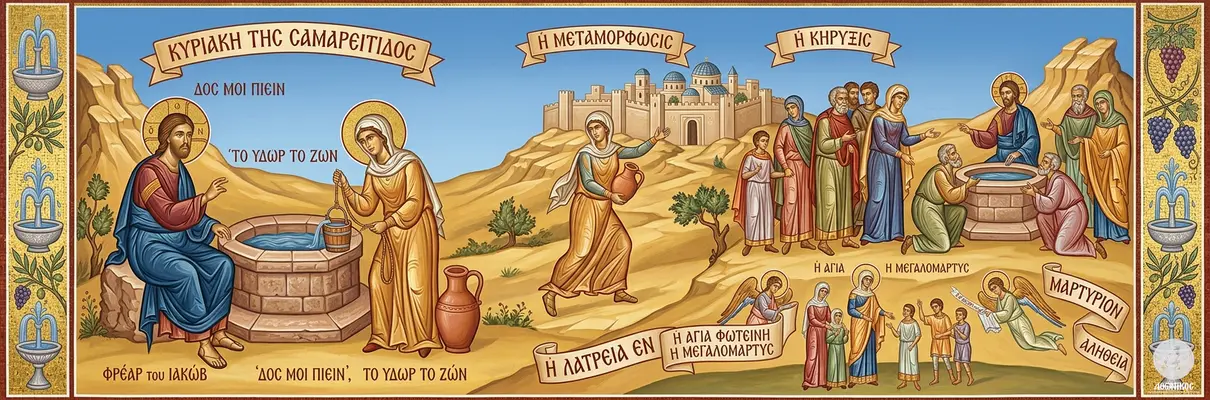
Sunday of the Samaritan Woman: The Thirst of the Soul and the Wellspring of Immortality
On Sunday, May 10, 2026, our Orthodox Church celebrates one of the most emblematic passages of theGospel of John: the encounter of Jesus Christ with the Samaritan woman at Jacob's Well. This is a dialogue that begins from the daily need for water and culminates in the revelation of the deepest truths of our faith.
The Historical and Social Context
The meeting takes place in Sychar, a city of Samaria. For a reader of that era, this dialogue was inconceivable for three reasons:
The National Enmity: The Jews and the Samaritans were in a permanent religious and ethnic conflict.
The Social Taboo: A teacher (Rabbi) was not permitted to converse with a woman in a public space.
The Moral Burden: This specific woman, by going to the well at noon (the sixth hour), was attempting to avoid the gazes of her fellow citizens due to her turbulent past.
Christ, however, as the universal Savior, transcends every barrier to save a single soul.
The Theological Analysis of the Dialogue
1. "Give Me a Drink": The Humility of God
The Creator of the seas and springs requests water from one of His creatures. This action demonstrates the ultimate humility of the Lord. He does not approach the Samaritan woman as a judge, but as a thirsty wayfarer. In this manner, He "unlocks" her heart and prepares her for the great gift.
2. The "Living Water"
Christ promises a water that whoever drinks of it will never thirst again. The Holy Fathers interpret the "Living Water" as the Grace of the Holy Spirit. Just as water is indispensable for biological life, so the Grace of God is the only thing that can quench man's existential thirst for meaning, love, and eternity.
3. Worship "in Spirit and Truth"
To the woman's question regarding where God ought to be worshipped (on Mount Gerizim or in Jerusalem), the Lord delivers the definitive answer: God is Spirit. True worship is not restricted by local or national borders. It takes place within the "in Christ" truth and through the power of the Holy Spirit that dwells in the heart of the believer.
The Transformation of the Samaritan Woman into Saint Photini
This woman, who had five husbands and was living with a sixth who was not her husband, is transformed in an instant. The moment Christ reveals to her the "secrets of her heart," she is not offended; instead, she recognizes the Prophet and the Messiah.
She leaves her water jar (a symbol of earthly bonds) and runs to the city. She becomes the first Equal-to-the-Apostles (Isapostolos), preaching Christ to the very people she was previously afraid to face. The tradition of our Church tells us that she was baptized with the name Photini and martyred under Nero in Rome, after first leading her five sisters and two sons to Christ.
Teachings of the Holy Fathers
Saint John Chrysostom: "Did you see the prudence of the woman? She did not ask about worldly matters, her health, or riches. She immediately asked about the dogmas of the faith. Even though she was a sinner, her soul thirsted for the truth. It is this thirst that saves man."
Saint Gregory Palamas: "Christ sat by the well weary. His weariness is our salvation. He thirsts for our return. Every time we approach the mysteries of the Church, we become partakers of that water which wells up into eternal life."
Spiritual Messages for Our Life
The Encounter in Everyday Life: Christ met the Samaritan woman during a mundane chore (the filling of the water jar). This teaches us that God meets us within our daily anxieties, provided the eyes of our soul are open.
The Avoidance of Condemnation: If Christ did not condemn a woman with such a past, who are we to condemn our brethren?
The Water Jar We Must Leave Behind: What is it that keeps us bound and prevents us from running toward Christ? Perhaps it is our passions, our egoisms, or our attachment to material goods.
The Sunday of the Samaritan Woman at Athonian.gr
This feast is closely intertwined with Mount Athos, where prayer and asceticism aim exclusively at tasting this "Living Water."
At our store, you can find unique spiritual provisions for this day:
Handcrafted Icons of Saint Photini: Crafted by Athonite fathers using traditional techniques. [See here]
Holy Water Vessels (Phiales): Symbolizing Jacob's Well, to transfer the blessing of the Church to your home.
Spiritual Readings: Studies on the Gospel of John to deepen your understanding of the meanings of this Sunday.
We pray that the Risen Lord quenches the thirst of your souls and that Saint Photini remains your protectress and guide toward the Light of Truth.
