
Cart is empty
 Books & CD/DVDs
 Orthodox Icons
 Monastic Handiwork
 Ecclesiastical Utensils
 Clothing & Accessories
 Natural Care & Remedies
 Prayer Ropes
 Jewelry
 Incense
 Wines
Wines
 Food
Food
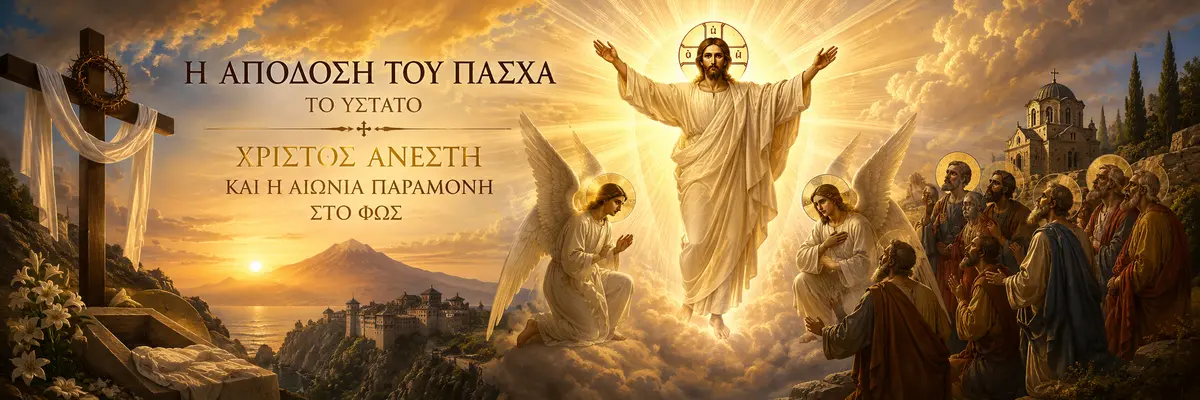
The Leave-Taking of Pascha: The Ultimate "Christ is Risen" and the Eternal Abiding in the Light
Introduction: The Closing of the Resurrectional Cycle
Forty days after the Holy Night of Pascha (Bright Night), the Church invites us to experience once again, for one final day, the triumph of the Resurrection. The Leave-Taking (Apodosis) of Pascha is not a simple liturgical epilogue; it is the culmination of a spiritual journey. It is the day we say farewell to the resurrectional greeting, closing our lips but opening our hearts wide, so that "Christ is Risen" may take root within us as a permanent state of existence.
Historical and Liturgical Elements: The Tradition of the "Eight Days" and the Formation of the Forty-Day Period
1. The Biblical Roots and the Institution of "Leave-Takings"
The institution of the "Leave-Taking" (Apodosis—which in ancient Greek signifies completion, return, or the festive closing of a celebratory period) is not a later invention of Christian worship, but has deep biblical and typological roots in the Old Testament. In the books of Leviticus and Numbers, God commands the Israelite people to celebrate the great feasts (such as Passover, Pentecost, and the Feast of Tabernacles) for eight consecutive days. The eighth day was called “atsareth” (a solemn assembly of departure) and was considered the climax and the seal of the entire feast.
The Early Christian Church adopted this pedagogical wisdom. She understood human weakness in grasping and assimilating the magnitude of a world-saving divine event in just a few hours. Thus, she established the "after-feast days," granting the faithful the necessary time to spiritually "digest" the divine mysteries.
2. The Historical Evolution of the Forty-Day Resurrectional Period
While for most Master Feasts (such as Christmas or Theophany) the Leave-Taking occurs on the eighth day (an eight-day celebration), the Church made a unique exception for Pascha, extending the period for forty whole days.
Historically, this formation stabilized around the 4th century AD, alongside the theological development of the festal calendar in the great Christian centers (Jerusalem, Alexandria, Constantinople). The choice of the number forty is not accidental, but is strictly based on the historical reality of the New Testament: it is the exact duration during which the Risen Lord remained on earth, secretly meeting His Disciples, healing their disbelief, and delivering to them the mysteries of the Kingdom of God before His glorious Ascension.
3. The Liturgical Uniqueness of the Day
From the perspective of the Typikon, the day of the Leave-Taking presents a unique distinctiveness found in no other feast. The Divine Liturgy of this Wednesday is not merely Paschal, but it is the faithful, exact repetition of the Nocturns and the Liturgy of the very Night of the Resurrection.
The priests vest once again in their most radiant, white robes. The Beautiful Gate and the Sanctuary doors remain wide open, symbolizing the empty tomb and the abolition of the middle wall of partition between God and man. Everything is chanted in the resurrectional tone, the faithful hold lighted candles, and "Christ is Risen" echoes dozens of times. This is a breathtaking liturgical "concession" of the Church, a second chance, a spiritual antidoron (blessed gift) for any Christian who, due to worldly anxieties or spiritual sluggishness, did not manage to deepen and taste the Resurrectional Light during the Holy Night of Pascha.
Theological Analysis & Patristic Teachings
1. The Mystical Extension of Joy
Saint John Chrysostom notes that the joy of the Resurrection must not be limited by time. In his famous Paschal Catechetical Homily, which we hear for the final time on the day of the Leave-Taking, he emphasizes: "Let no one bewail poverty... let no one mourn for transgressions." The Fathers explain that this forty-day remaining of Christ on earth was an act of ultimate condescension, so that the Resurrection could be touched and perceived by our own "faithless" nature, just as it happened with Thomas.
2. From Earth to Heaven: The Bridge of the Ascension
According toSaint Gregory Palamas,the Leave-Taking of Pascha hides within it a sweet sorrow (charmolypi). Christ is preparing to ascend into the heavens, not to abandon us, but to open the way for our own ascent. "Christ is Risen" gives way to "O Lord, You ascended in glory," proving that the Resurrection of the body is fulfilled with the deification (theosis) of man at the right hand of the Father.
Spiritual Messages for Our Life
The Light That Does Not Fade: Although the resurrectional candles are liturgically extinguished on this day, the Light of the Resurrection must remain unquenchable in our daily lives. The Leave-Taking reminds us that a Christian is a "resurrectional being" who never despairs.
The Cure for Sorrow: The Saints of our times, such as Saint Porphyrios and Saint Paisios, emphasized that for the believer, there is no room for melancholy. "For the Christian, every day is Pascha," they would say. The Leave-Taking is the reminder that death has been definitively conquered.
The Blessing of the Leave-Taking at Athonian.gr
On Mount Athos, the Leave-Taking of Pascha is experienced with festive, all-night vigils that last until dawn, as the monks chant "Christ is Risen" with a unique, heavenly intensity that shakes the katholikons of the monasteries.
At our store, you can find the necessary spiritual provisions to keep this resurrectional blessing alive in your home throughout the year:
Athonite Incense: To renew the deeply prayerful atmosphere of Pascha at your home icon corner.
Resurrection Icons: Handcrafted icons of the "Harrowing of Hell" (The Descent into Hades), fashioned by Athonite fathers as an enduring symbol of victory over darkness.
Athonite Pure Beeswax Candles and handcrafted products: To light during this final resurrectional prayer and bring blessings to your home.
